

Christian Feast
The Feast of the Dormition of the Holy Mother of God, also known as Grape Blessing (Khaghoghorhnek), is the fourth of the five major tabernacle feasts of the Armenian Apostolic Holy Church. It is the oldest feast dedicated to the Holy Virgin Mary and is distinguished by its Christian historical layers as well as by its everyday and cultural traditions, which originated in ancient times and have continuously developed within the Christian environment.
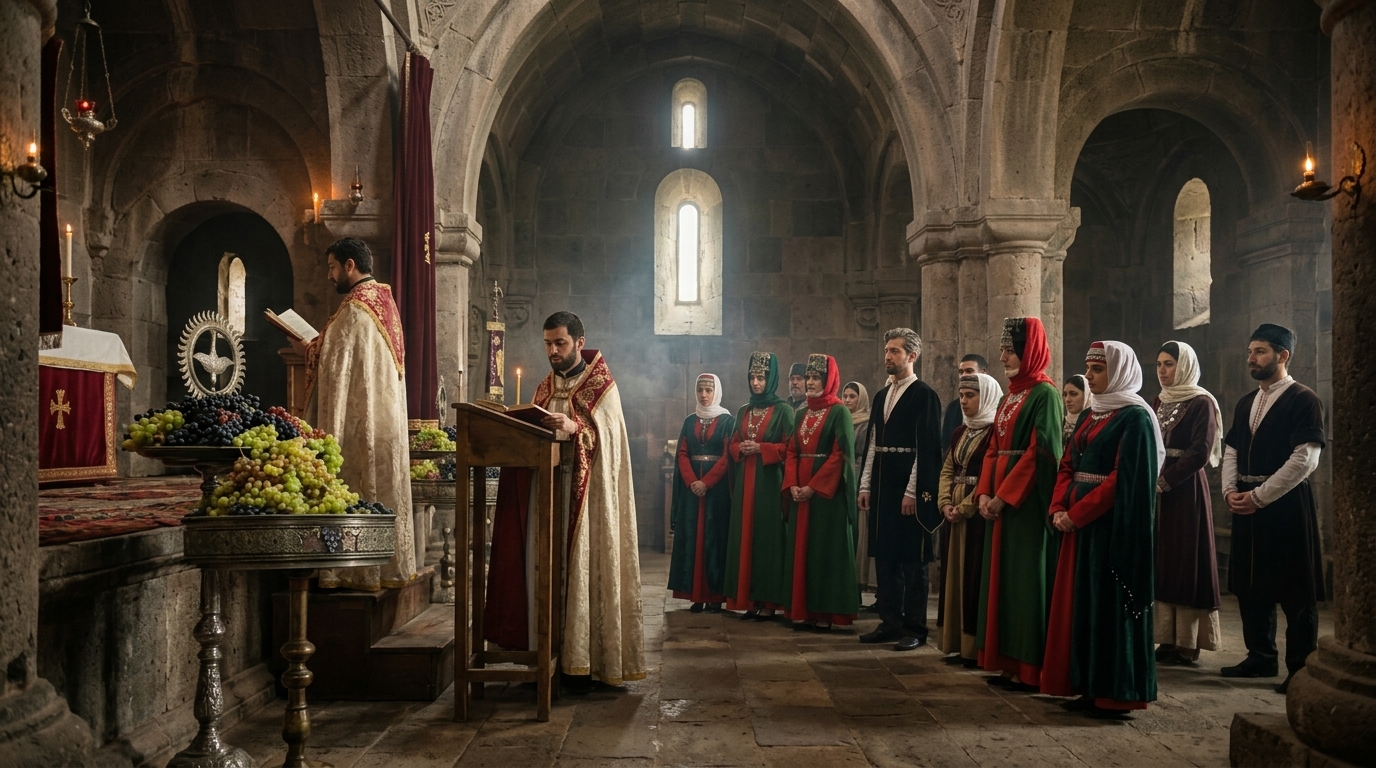
The Feast of the Dormition is celebrated on the Sunday closest to August 15 of the given year. During the Divine Liturgy, the faithful participate in prayers and church readings that emphasize the divine mission of the Mother of God and the devotion of believers. In the Armenian Apostolic Church, the Feast of the Dormition of the Holy Mother of God is notable for coinciding with the time of year when grapes ripen. This period unites pagan traditions of grape blessing with the Christian faith.
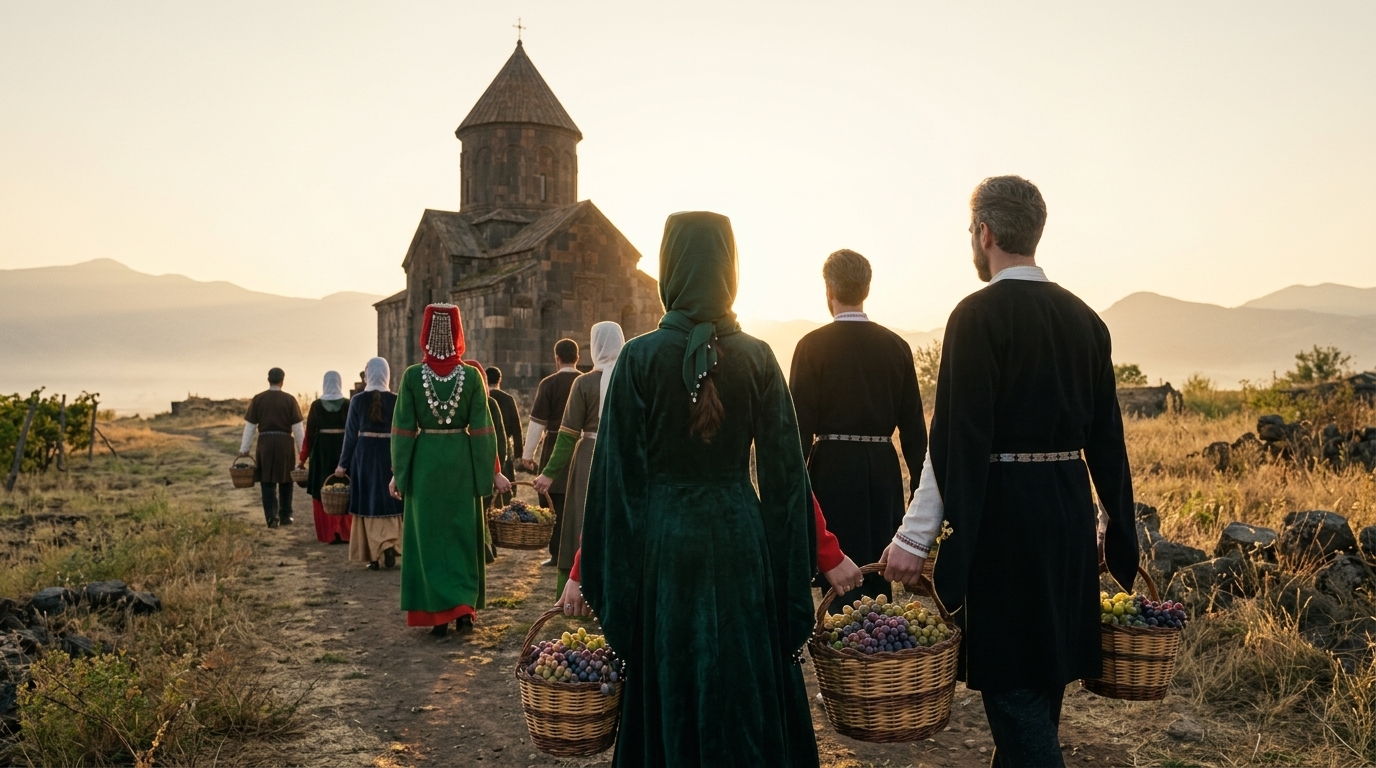
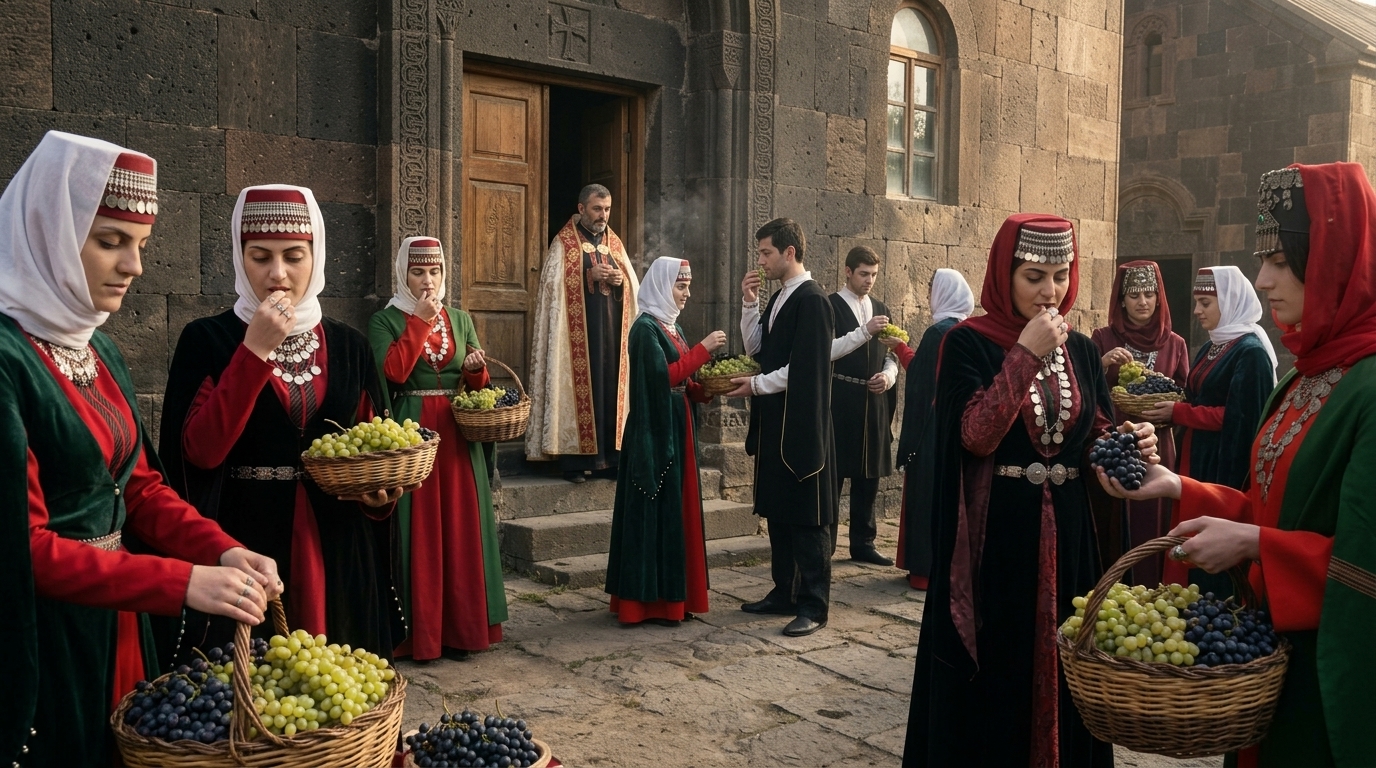
On the feast day, after the Divine Liturgy, the ceremony of the Grape Blessing is performed, during which the entire year’s harvest is blessed, and only after this blessing is it permitted to eat grapes. Blessed fruits are also used to prepare blessed wine, which is kept until the next year’s Grape Blessing as a symbol of goodness, abundance, and prosperity.
The Connection Between the Feast of the Dormition of the Holy Mother of God and the Grape Blessing
After the expulsion from Paradise, since humankind had been appointed to rule over the whole earth, the curse placed upon humanity extended to all creation under its dominion—the earth together with its animal and plant life. However, the blessing remained upon all living creatures. Among fruits, the cluster of grapes was blessed in a special way, because the Lord exalted the vine and honored it above all other plants by giving Himself the name of the Vine, according to the divine word: “I am the true vine” (John 15:1).
The branches are lovingly bound to the Lord, and the Father, the cultivator and saving Father, prunes the vine so that it may bear fruit in righteousness; the pruned branches, however, become fuel for eternal fire. The Lord made the vine the substance of His Blood and, taking it into His hands in the Upper Room, blessed it, saying: “This is My Blood of the New Covenant” (Matthew 26:28), through which we were freed from the bondage of sin and death. Thus, the grape received a double blessing.
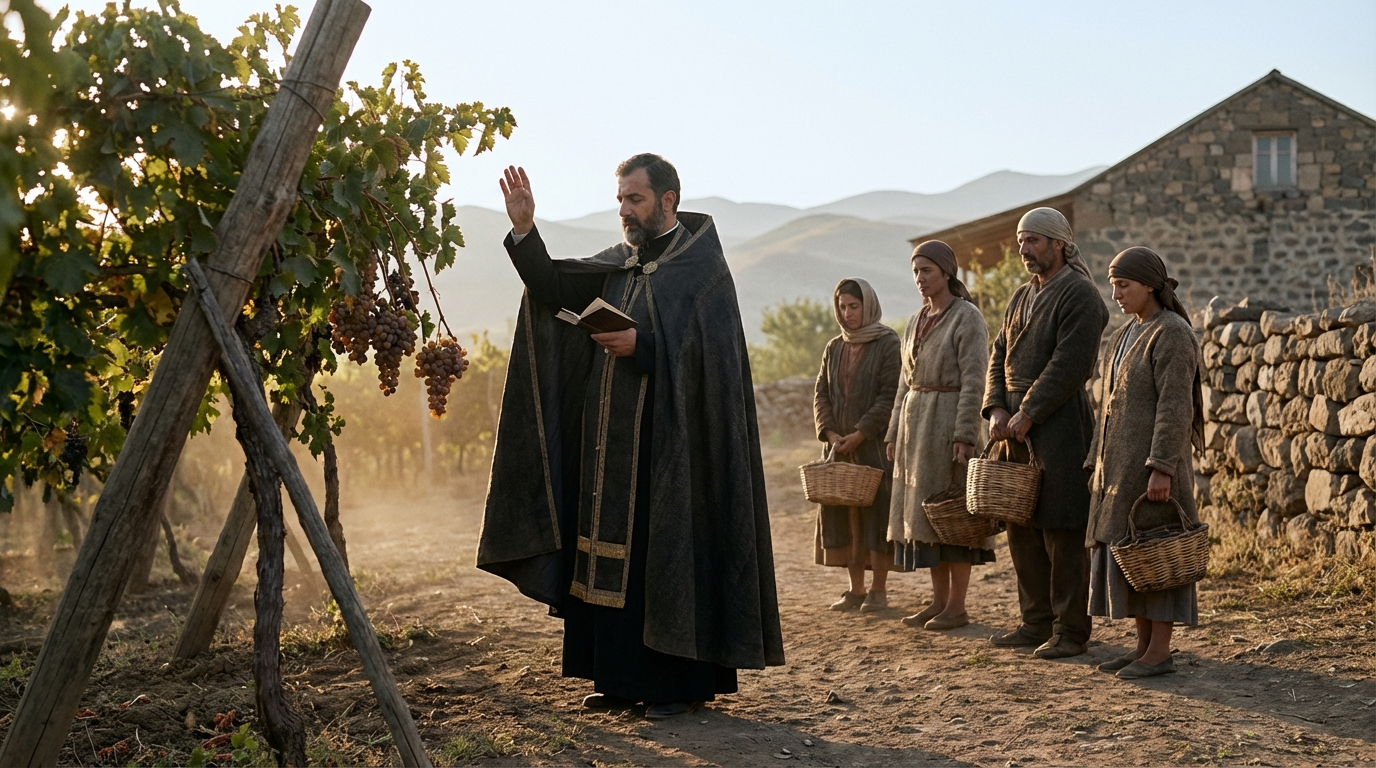
For this reason, on the Feast of the Dormition of the Holy Mother of God, after the Divine Liturgy, the Grape Blessing ceremony is performed. During this rite, through the deacon’s proclamation, thanksgiving is offered to the beneficent God for the abundant harvest of fields and vineyards granted to us, and we implore Him to bless the fruits brought to the church with His original blessing and to grant us grace to receive them as wine that brings joy and as food that brings health to soul and body, through the grace of Christ
(“Information Department of the Araratian Pontifical Diocese // 2024-08-26 // qahana.am/post/222”).
Historical Overview
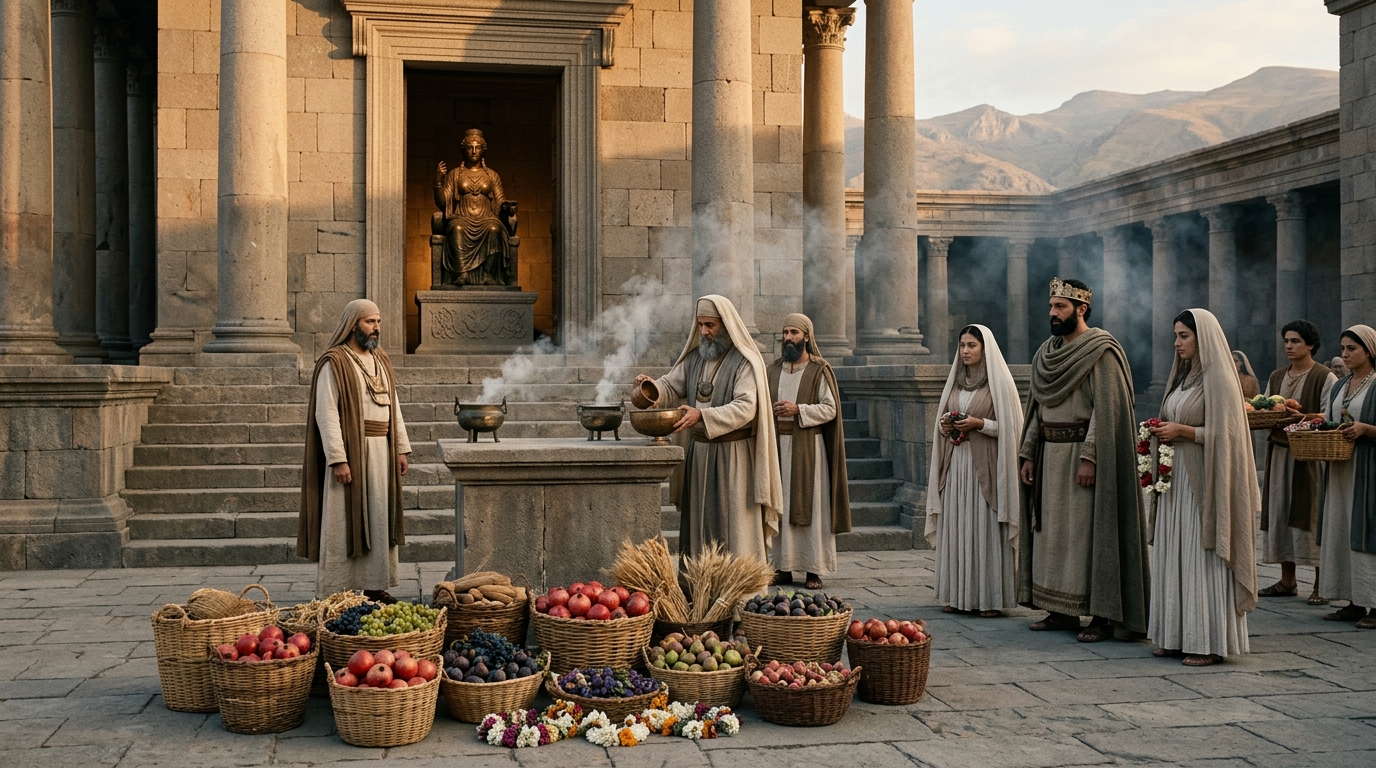
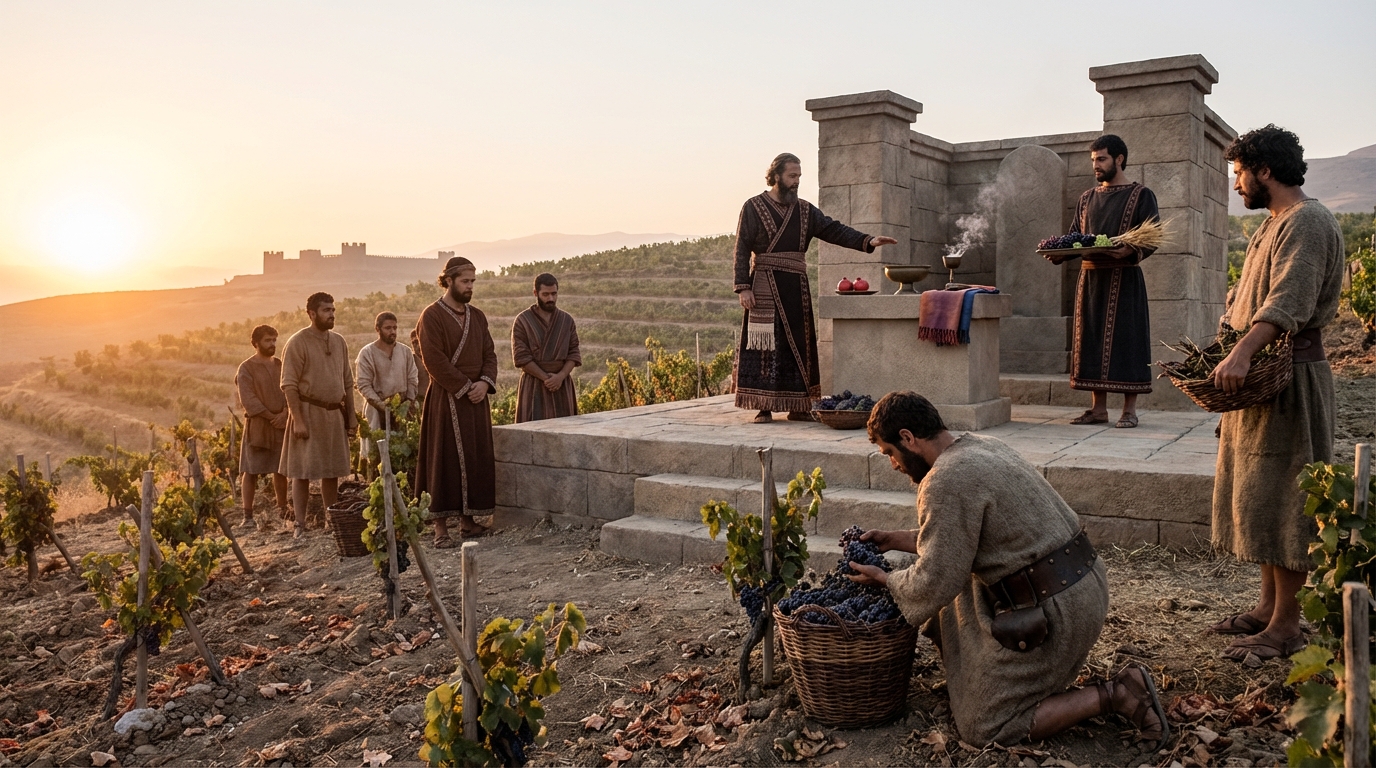
Already in the pre-Christian period, the “Festival of First Fruits and Harvest” was widespread. During this ritual, the first harvest of the year was offered to the deity embodying fertility in the pantheon of the people performing the rite, as a sign of obedience, submission, gratitude, and hope for abundance in the coming year. In the pre-Christian Armenian pantheon, the goddess of fertility was Anahit, whose feast was celebrated on the eleventh day of Navasard (August) (Karapetyan 1998, 182). This principal feast of Anahit was celebrated with great splendor in the district of Eriza, with the participation of kings and their retinues (Melik-Pashayyan 1963, 136).
Thus, even in antiquity, the festival and its accompanying rituals were held in mid-August. It should be noted that oral testimonies in folklore concerning the ritual tasting of the first fruits of the year are numerous, especially in poetic works, such as “Akh Nubar, taja nubar” (Melikyan 1949, 220) or “Hay Nubar, Nubar, Nubar” (Bense 1972, p. 88). S. Harutyunyan notes that the word “nubar” in Persian means “new fruit” (Harutyunyan 2001, 50); given the close relationship between the Armenian and Persian languages, this comparison is clearly appropriate.
In general, a fruit such as grapes—which simultaneously provided wine, vodka, juice, dried fruit, and raisins, and was also used in various dishes—naturally deserved greater praise than any other fruit.
First they planted the grape,
And loudly praised it (Kostanyants 1892, 41–47).
O grape, you must be praised,
You are the fruit of immortality.
They harvest you and take you to the winepress,
They crush you and give you to one another,
They take and pour you into the barrel (Kostanyants 1892, 46–47).
Some folklorists trace the origins of the Feast of the Grape Blessing to the period of the Kingdom of Van, referring to the Khaldian festivals frequently mentioned in the inscription of the Gate of Meher, known from that era, “during which various rituals of establishing vineyards, pruning, tending, and harvesting grapes were performed” (Hmayakyan 1990, 76).
Ethnographer Samvel Mkrtchyan also draws attention to the parallels between the pre-Christian background of the feast and the early formation of Christianity, citing in turn the “festival of grapes and harvest” mentioned on the Gate of Meher, “which, in terms of timing and content, had certain similarities with the summer Navasard and the Dormition of the Holy Mother of God or Grape Blessing feasts of the Arsacid period” (Mkrtchyan 2010, 107).
Gohar Vardumyan does not consider it accidental that “it is precisely the ritual of the Grape Blessing that has been preserved in the festive calendar of the Armenian Church, through which the first harvest is offered to God and blessed, and then presented to the people.” Moreover, “in the Christian world, perhaps only the Armenian Church celebrates such a feast, thus also preserving the memory of wine being regarded as the blood of Jesus” (Vardumyan 2020, 181).
In this context, it is also extremely interesting that “the Son of God himself was often likened to the grapevine, and the wine used in the ritual of the Holy Liturgy was made from grapes” (Mkrtchyan 2010, 106–107), or that already in the later Christian period wine was clearly identified with the blood of the Son of God. The ideological culmination of this concept in Christianity is Christ’s message to his disciples during the Last Supper, when he hands them the wine and says: “This is my blood.” In this regard, particularly notable are the “cups of life” consumed during church feasts, which had to be drunk to the end, as they symbolized life itself (Akinian 1921, 106–117). Armenians regarded wine as the blood of grapes, which symbolized the blood of the Savior (Petrosyan 2002, 423).
In Christian Armenia, wine drinking was so widespread, and wine was so strongly associated with Jesus Christ, that people who exceeded moderation in drinking often even justified themselves, saying: “How else should our Christianity be manifested? We are not Turks—Christians must drink wine; wine is the blood of Christ” (E.Ts.V.M. 1905, 221).
In the Bible we read God’s command to the Prophet Moses:
“When you enter the land that the Lord your God is giving you as an inheritance, and you take possession of it and settle in it, you shall take some of the first of all the fruit of the ground, which you harvest from the land that the Lord your God is giving you, and you shall put it in a basket and go to the place that the Lord your God will choose to make his name dwell there. You shall go to the priest who is in office at that time and say to him, ‘Today I declare to the Lord your God… And now, behold, I have brought the firstfruits of the land that the Lord has given me’” (Deuteronomy 26:1–3, 10).
Later, the Grape Blessing ceremony was enriched with prophetic, evangelical, and apostolic readings, as well as with a special prayer composed by Catholicos Nerses Shnorhali:
“…Bless, O Lord, the vines and their vineyards from which these clusters for blessing were cut and offered to the Holy Church. Make them abundantly fruitful, so that they may resemble fertile and fruitful soil. Protect, O Lord, the gardens and fields from all calamities that descend from above because of our sins—hail, destructive frosts, scorching winds, and harmful worms…” (Book of Feasts, vol. II, p. 201).
The Feast of the Grape Blessing in Different Ethnographic Regions of the Armenian Highlands
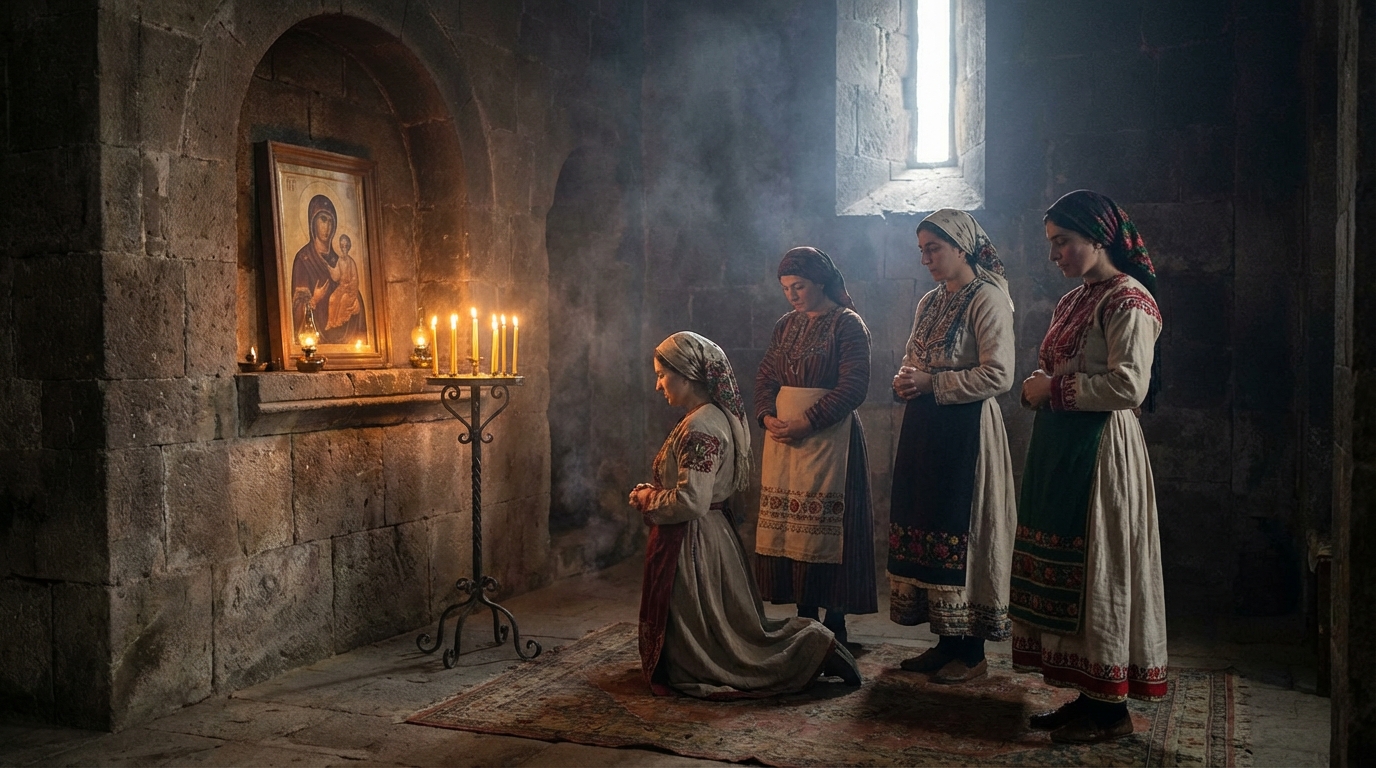
The Feast of the Dormition of the Holy Mother of God, or Grape Blessing, was also known in different ethnographic regions under various names, such as Easter of the Mother of God, Grape Easter (Musa Ler), Astvaratsin (Hark–Bulanikh), Astadzadzin (Vank–Meghri), and others. In many regions, the Feast of the Dormition of the Holy Mother of God was also referred to as the Feast of the Blessing of Fruits, used as a synonymous designation (Mkrtchyan 2010, 107). In certain areas, women on that day prayed to the Holy Mother of God, asking her to grant them children and to protect them: “Probably no saint received as many prayers as Mary” (Kharatyan–Arakelyan 2005, 228).
- Hovsepyan reports that in Karadagh the Feast of the Grape Blessing was not only regularly celebrated but was so beloved that a legend was even woven around it:
“According to tradition, when Noah sends the dove to bring news, the dove meets Christ. Christ gives the dove a cluster of grapes, blesses it, then takes a cup of wine, touches the grape cluster with it, and says: ‘Take this and give it to Noah, for the wine is my blood and the grape is my body. Let him believe and have no trace of fear; let him believe and come out of the Ark and descend upon the earth.’ That is why a Christian should not eat grapes until the Feast of the Grape Blessing, as the fruit blessed by Christ. On that day grapes were brought to the church, blessed, and after the Divine Liturgy distributed among the people” (Hovsepyan 2009, 421).
In some ethnographic regions, people even believed that the grapevine was a divine gift given to Noah in return for his great sufferings, so that he might make wine and drink it (Melik-Shahnazaryants 1902, 1). Noah was even regarded as the patron saint of the wine merchants’ guild of Tiflis (Hobosyan et al. 2021, 98; Yeziyzaryants 1891, 1–2).
In Meghri, for example, in earlier periods the Feast of the Grape Blessing was so important that before the performance of the ritual associated with the feast and the lifting of the grape fast, anyone who ate grapes would not only be reprimanded by the priest but could also be beaten or imprisoned by the head of the household (HAA, fund 428, file 4). However, the same source elsewhere reports that by the beginning of the nineteenth century the feast had already begun to lose its widespread popular significance.
In Javakhk, one or even two weeks before the feast people already observed a fast: “…I have taken hold of the ‘foot’ of the Holy Mother of God, meaning that, in addition to the fast of the Holy Mother of God, I have voluntarily begun fasting a week earlier” (Lalayan 1896, 371). The Grape Blessing fast was also preserved in the Sisian region:
“…when they bless and distribute [the grapes] in the church to the attendees, who seize them noisily from one another and eat them, the people then begin to consume grapes” (Lalayan 1898, 260).
The same fast was observed in Shirak as well (Mkhitaryants 1901, 273), while in Lori, for example, Yervand Lalayan notes that people (from the Odzun area) made pilgrimages to the churches of Holy Mother of God or Khachgund in Odzun (Lalayan 1903, 267). This period was generally called “Mary’s fast,” “Mariama fast,” or “the fast of the Mother of God.”
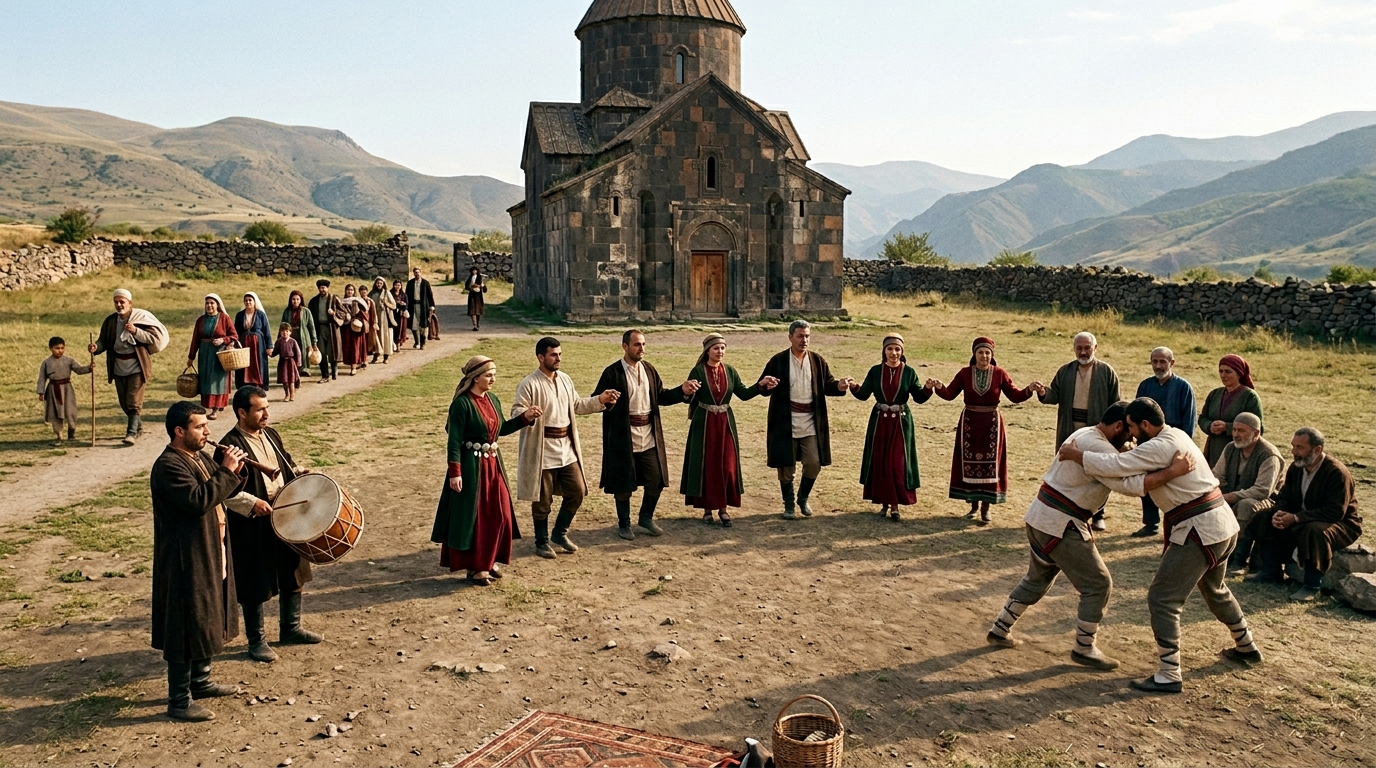
Before lifting the fast, the priest would often go to the vineyard and begin the ritual there. He would pronounce blessings, such as: “From the light of heaven, O Tukh-Manuk, these clusters of our vineyards have been sprinkled” (Kharatyan–Arakelyan 2005, 230). In different ethnographic regions, festive games—such as wrestling, stick games, or dances—would begin on the day following the Grape Blessing.
The day of the Grape Blessing, its eve, or the day following it was also considered a day of pilgrimage. Well-known pilgrimage sites existed throughout the Armenian Highlands. In Gardman, for example, the sanctuary of Pandasari, ‘Pandi the Saint,’ was famous—a localized form of the name of Saint Panteleon. Another well-known pilgrimage site in Gardman was the shrine of Ruskan Hatak or Huskan Nahatak, which, according to tradition, is the burial place of a brother and sister killed by enemies. It enjoyed great renown throughout the region, and pilgrims even came from Gandzak to visit it.
Pilgrimages were also undertaken in other regions. For example, in the village of Bjni in Kotayk Province, the Feast of the Grape Blessing is still considered a pilgrimage day, since the main church of the village is dedicated to the Holy Mother of God, and many families offer sacrificial offerings on that day. Similar pilgrimages also take place in Tavush (Haghartsin Monastery) and in Yerevan (at the Holy Mother of God Church in the Nork–Marash administrative district).
Conclusion
The Feast of the Dormition of the Holy Mother of God, or the Grape Blessing, is one of the most significant feasts of the Armenian Apostolic Holy Church. It brings together the faithful by reflecting devotion to the Holy Virgin Mary and the traditions of Christian ritual practice. The feast is celebrated at the time of year when grapes ripen, and the rite of the Grape Blessing symbolizes the inseparable connection between faith, grace, and the continuity of life. The blessed grapes and the wine prepared from them represent not only material abundance but also a spiritual value, serving as a symbol of a direct connection with God.
Historical evidence shows that certain ancient traditions—particularly rituals associated with the goddess Anahit—were later adapted and linked to the veneration of the Holy Mother of God. This adaptation is exclusively cultural in nature and does not distort the true essence of Christianity; rather, it reflects the manner in which each people has sought to integrate ancient customs within the framework of a new faith.
Thus, the Feast of the Grape Blessing simultaneously reflects Armenia’s national culture, ecclesiastical faith, and communal values, affirming the true path of Christianity and reminding believers that communion with God and prayer are always intertwined with both the everyday and spiritual dimensions of life.
List of References
Akinian, N., Five Wandering Poets…, Vienna, 1921.
Arthur Deacon Karapetyan, Grape Blessing, Ejmiatsin, 1998, nos. 8–9, pp. 182–184.
Bense, Armenian Ethnography and Folklore, vol. 3, Yerevan, 1972.
E.Ts.V.M., Drunkenness and Its Consequences and Sobriety as an Evangelical Requirement, Ararat, 1905, Vagharshapat.
Yeghiazaryants, S., Guild Associations, Mshak, 1891, no. 7, pp. 1–2.
Lalayan, Y., The Borchalu District, Ethnographic Journal, vol. 10, 1903, pp. 249–268.
Lalayan, Y., Javakhk, Ethnographic Journal, 1896, vol. A, pp. 371–378.
Lalayan, Y., Sisian, Ethnographic Journal, 1898, no. 1, pp. 249–260.
Kharatyan-Arakelyan, H., Armenian Folk Festivals, Yerevan, 2005.
Kostanyants, K., New Collection…, part B, Tiflis, 1892.
Harutyunyan, S., Ancient Armenian Beliefs, Religion, Worship, and Pantheon, Yerevan, 2001.
Hobosyan, S., Gasparyan, B., Harutyunyan, H., Saratikyan, A., Amirkhanyan, A., The Armenian Culture of Grapes and Wine, Yerevan, 2021.
Hovsepyan, H., The Armenians of Karadagh, vol. 1, Ethnography, Yerevan, 2009.
Melikyan, S., Armenian Folk Songs and Dances, vol. I, Yerevan, 1949.
Melik-Shahnazaryants, K., Practical Guide to Winemaking, Tiflis, 1885.
Melik-Pashayyan, K., The Cult of the Goddess Anahit, Yerevan, 1963.
Mkhitaryants, Agh., Fragments from the Granaries of Shirak, Eminian Ethnographic Collection, vol. A, Moscow–Vagharshapat, 1901, pp. 261–274.
Mkrtchyan, S., Tonr: Armenian Folk Rituals, Customs, and Beliefs (Tradition and Modernity), Yerevan, Gasprint, 2010.
Petrosyan, H., Medieval Armenian Concepts of the Ideal Living Space and Life Process: The World as a Garden, Handes Amsorya, 2002, nos. 1–2, pp. 411–440.
Vardumyan, G., Manifestations of Folk Christianity in Armenian Festive Life, Historical-Philological Journal, 2020, no. 1, pp. 163–186.

 +374 44 60 22 22
 Armenia Wine Company 3 Bild., 1Dead-end, 30 Street, Sasunik 0223

